
|
 |
Committees
- Archaeology
- Archives & Displays
- Business & Industry
- Genealogy
- Historical Sites
- Meetings & Programs
- Natural History
- Newsletter & Publications
- Oral History
- Social History
- Special Activities
- Willow Grove Park
The Natural History Committee
Natural History encompasses the study of plants, animals, climate, and geology that are native to an area. It is important to study this history so that one can understand what is natural in the ecosystem and how to preserve that ecosystem. When large scale changes are made, such as building without consideration of the ecosystem, we create soil erosion, flooding, and extinction of wildlife, insects and plants. Also, when animals, plants, and insects are brought into a location not native to them, the balance in nature is shifted.
The Natural History Committee hopes to be able to discuss various topics in Natural History and to encourage people to assist in the preservation of the ecosystem.
Go Green with Native Plants
Spring is coming and we are starting to think about our gardens. As we do, why not consider some native plants this year?
Native plants are "at home" in the soil where they originated and are rarely attacked by insects. They have adapted to our culture and can withstand the growing conditions found here. Never remove them from the wild, however. It depletes the native population and many do not survive transplanting.
Many retail nurseries and mail order catalogs also offer native plants. Make sure they are propagated at the nursery and not taken from the wild.
Excerpts from a 2007 article by June Crippen, Natural History Committee.
Pennypack Plant Sales 2013
Friday, May 3th from 2:00pm to 7:00pm
Saturday, May 4th from 10:00am to 3:00pm
Preserve Natural History in Your Own Backyard with a Little Help from the Audubon Society
In fall 2010, Upper Moreland became the State's first Bird Town through the efforts of the PA Audubon, the Township Environmental Advisory Council and the Parks and Recreation Department.
The purpose is to restore a more natural habitat to help conserve energy, fresh water and natural plants, shrubs and trees. This will in turn attract native species and restore a balance ecological system. The birds are usually the last species to return and indicate balance is being achieved. If people adopt this program, it will save money for individuals and the township.
The goal is to increase habit diversity for birds, insects and butterflies, minimize run off, decrease use of synthetic fertilizers and chemicals and minimize greenhouse gases. A major impact can be made by using native plantings in the right location.
For a nominal fee, Audubon will send trained representatives to your property to give advice. It is not necessary to overhaul your yard all at once but to gradually work to create a balanced environment.
If you are interested on obtaining this service, please contact the Parks and Recreation Department at 215-659-3100 x1039.
What Earthquake?
Many do not realize that earthquakes also happen on the East Coast and can be felt in Southeastern Pennsylvania. Southeastern Pennsylvania is the State's most seismically active region. It is not known to have experienced an earthquake with a magnitude greater than a 4.7, but the historical record only goes back about 200 years. There is no obvious reason to conclude that an earthquake of a higher magnitude could not occur.
The majority of earthquakes occur along the boundaries between tectonic plates on the Earth's crust. Eastern North America, including Pennsylvania, is about 2000 miles away from the nearest plate boundary - the Mid-Atlantic Range. The Eastern States, however, do experience a moderate level of seismic activity, including occasional earthquakes.
The Seismic activity in the East may be related to what happened about 200 million years ago. At that time, the supercontinent of Pangaera broke up and the Atlantic Ocean began to form. This event called rifting by geologists produced many faults, and some of these faults may be experiencing reactivation by present day stress, which is squeezing eastern North America in a roughly east-west direction.
Many earthquakes occurred outside the State but were felt in Pennsylvania. A strong quake on December 18, 1737 toppled chimneys in New York City and was felt in Boston, MA, Philadelphia, PA, and New Castle, Delaware. Other shocks that occurred outside the State were felt in 1758, 1783, and 1791. In 1800, two earthquakes (March 17 and November 29) were reported as "severe" at Philadelphia. On November 11 and 14, 1840, earthquakes at Philadelphia were accompanied by a great and unusual swell on the Delaware River.
Dishes were thrown from tables (intensity 5) at Allentown by a strong shock on May 31, 1884. Towns from Hartford, Connecticut to West Chester, PA reported fallen bricks and cracked plaster from an earthquake centered near New York City on August 10, 1884.
On December 27, 1961, the northeast portion and suburbs of Philadelphia noticed a disturbance that shook buildings, rattled dishes, and disturbed other objects. Police and newspaper offices received numerous calls from alarmed citizens.
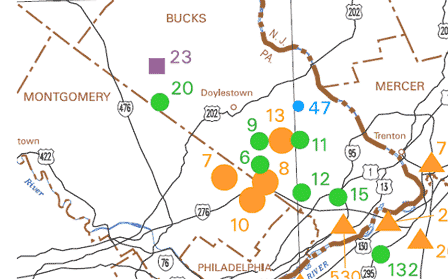
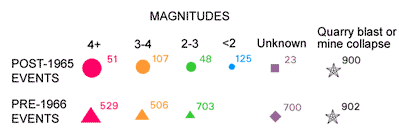
The above map of the local area shows where earthquakes have occurred in our region. Pennsylvanians will probably continue to feel small earthquakes generated on local faults. A large local earthquake of a magnitude greater than 6, though unlikely, is not impossible. It is always wise to take certain precautions such as emergency planning. This would include having on hand a flashlight, battery-powered radio, water and food supply, and a first aid kit.
The source for the material for this article came from the USGS Website, as well as from the Commonwealth of Pennsylvania, Department of Conservation and Natural Resources, Bureau of Topographic and Geologic Survey Website.
Excerpts from a 2007 article by Bob Crippen, Natural History Committee.